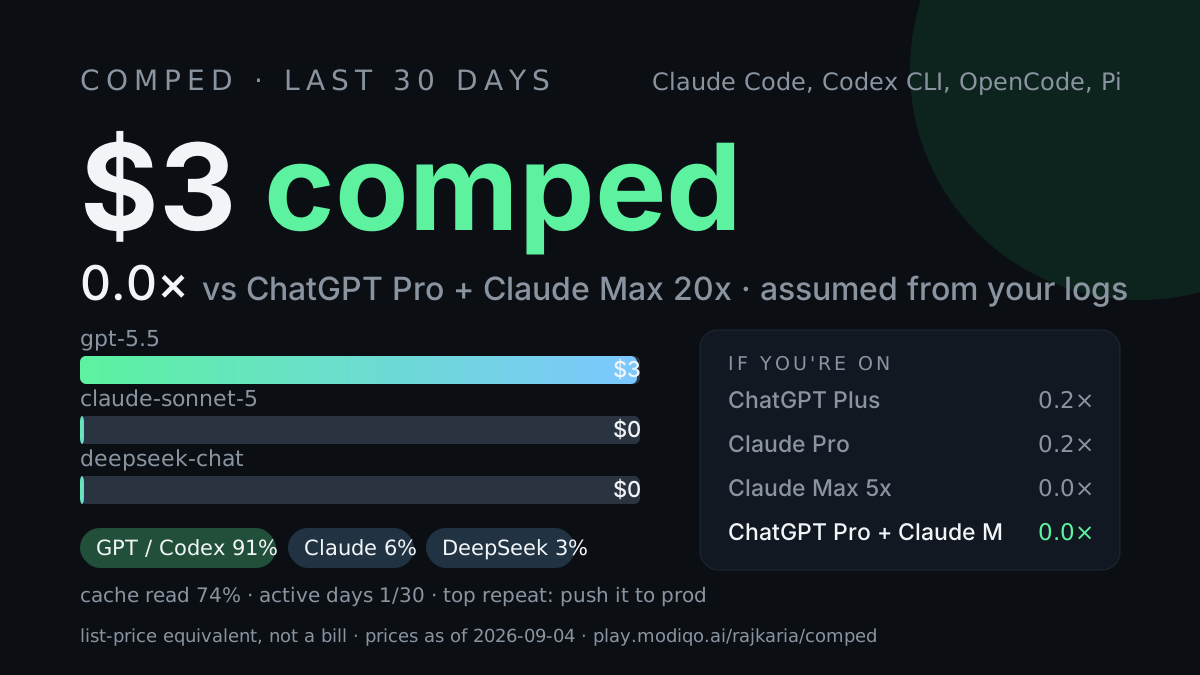
Is the number a bill? Do I owe this?
No. You're on a subscription and you paid what you paid. The number is what the same work would have cost at the provider's public API prices. It's there so you can see how much your plan is actually worth to you.
What goes on the leaderboard, exactly?
Your handle (or anon-xxxx if you didn't give one), the comp score, its tier, the full-price total, the plan it was scored against and its price, which AIs and tools were found, the window in days, active days, session count, cache-read share, and a random id so a re-run replaces your row. That's the whole list. It's written to ~/comped/comped-rank.json before it's sent, so you can check.
Can I get the card without going on the board?
Yes. Add leaderboard=false to the line, like this: curl -fsSL https://gotcomped.com/comped.sh | sh -s -- leaderboard=false. Then the run makes no network calls at all. Already on the board and want off? Open an issue with your handle and the row goes.
Do I need to know how to code?
No. If you use an AI coding tool you've opened Terminal before. Copy one line, paste it, press Enter. That's it.
Do I need an account?
No. The line above installs nothing and signs you in to nothing. Without a name you go up as anon-xxxx; to claim one, put handle=yourname on the end of the line, after sh -s --: curl -fsSL https://gotcomped.com/comped.sh | sh -s -- handle=yourname. The -s -- is what makes sh pass it through, so | sh handle=yourname will not work. The leaderboard page has it as a copy button.
What is "rote", and do I need it?
rote is a free command-line tool from Modiqo that runs small, versioned programs called Plays. comped is one, and running it that way gives you a consent screen listing every file it will touch, plus a public archive you can read before anything happens. It is the careful way in, and it needs a free Modiqo account. The line above is the quick way in. Same code, same card, same numbers. Both are in the docs.
Which tools does it read?
Claude Code (including sub-agent transcripts), Codex CLI, Pi and OpenCode. Ones you don't have are skipped. If you've pointed one of them at another provider, like Kimi, GLM, DeepSeek or Gemini, that's found and priced too.
How does it know my plan?
It doesn't, and it doesn't try to find out, because that would mean reading your account, which it refuses to do. Instead it prices every plan your provider sells and marks the most expensive one that fits. Your real score is at least that. Find your row for the exact one.
Why does it say "assumed"? Can't it tell if I'm on Pro or Max?
No, and neither can anything else that only reads your logs. A Pro session and a Max session look exactly the same. The only file on your computer that knows your tier is your account file, and we won't open it. So the card scores every tier and assumes the priciest one that fits, which is the smallest number you could honestly claim. Say plan=claude-pro-20 once and it remembers.
Windows?
Yes, with npx comped. It needs node and Python but no Unix shell, and every commit installs and runs it on a Windows machine before it ships. The curl line is the one that needs a Unix shell, so for that use WSL. You can also download the archive, unpack it and run py comped.py.
Can I see it work before pointing it at my own stuff?
Yes. The tool ships with sample logs. The docs have the one-liner that runs on those first.